
| Utgivelsesdato | Juni 2026 |
| Forfatter | |
| Pris | 455 NOK |
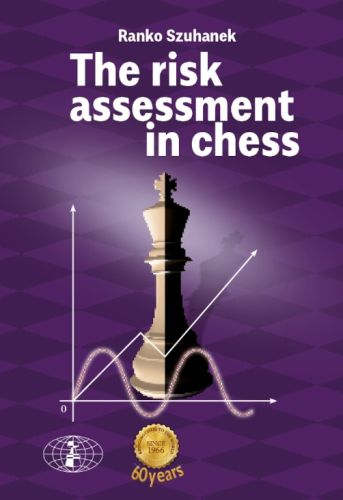
The risk assessment in chess
Forlagets egen omtale
PDF-utdragRisk is a fundamental element of human activity, from ancient advisory systems in Babylon to modern concepts of risk assessment and management used in engineering, finance, and safety systems.
Chess, although deterministic and without randomness, provides a highly dynamic model of decision-making under uncertainty. Each move changes the nature of the position, creating new possibilities while simultaneously introducing new risks, including counterplay for the opponent. The balance between initiative and vulnerability is therefore central to correct evaluation.
In this sense, chess can be viewed as a practical laboratory of risk management: players assess positions, anticipate scenarios, and choose between competing lines under time pressure, often relying on a combination of calculation and intuition. These processes closely mirror analytical methods used in risk assessment models.
Beyond the board, chess develops discipline, strategic thinking, and decision-making skills applicable in many fields, including management and complex system analysis. It trains the ability to act under pressure, evaluate incomplete information, and adapt to changing conditions.
Ultimately, chess represents a structured form of controlled risk, where success depends on accurate evaluation, timely decisions, and the ability to balance calculation with practical judgment.
Innhold
004 System of signs
007 From the Author
011 Steps of risk assessment process
Chapter 1
017 Opening disaster
Chapter 2
035 Gambits - past and present
Chapter 3
071 The element of surprise
Chapter 4
117 Playing for a draw can hardly be recommended
Chapter 5
143 Is a rare variation a good choice?
Chapter 6
177 The positional sacrifice
209 Epilogue
229 About the Author
007 From the Author
011 Steps of risk assessment process
Chapter 1
017 Opening disaster
Chapter 2
035 Gambits - past and present
Chapter 3
071 The element of surprise
Chapter 4
117 Playing for a draw can hardly be recommended
Chapter 5
143 Is a rare variation a good choice?
Chapter 6
177 The positional sacrifice
209 Epilogue
229 About the Author
| Innbundet? | Ja |
| Type | Bok |
| Språk | Engelsk |
| Antall sider | 232 |